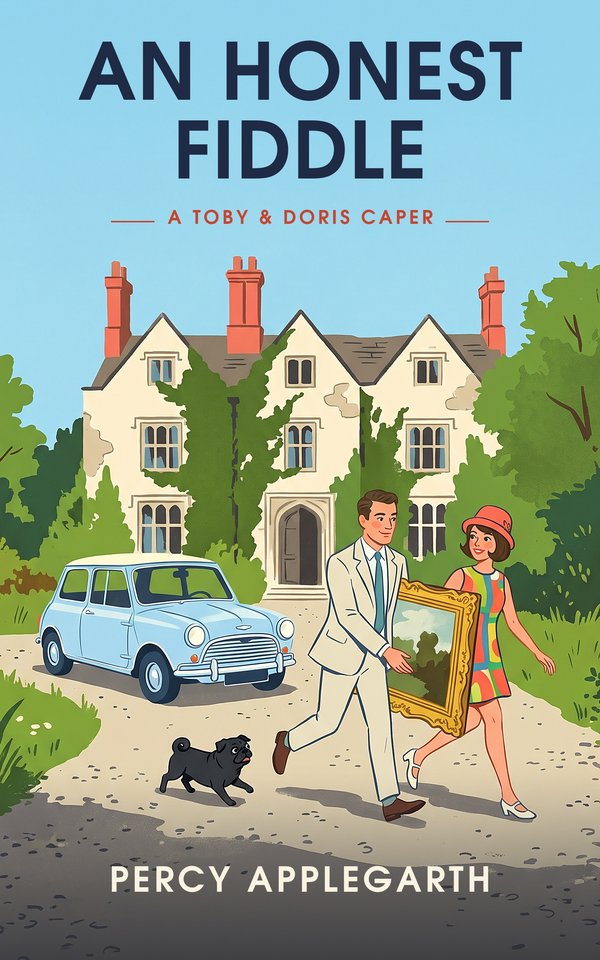
An Honest Fiddle
June 1968. Toby Lockhart owes three thousand pounds to a bookmaker who speaks very softly and keeps very neat accounts. He has fourteen days.
Toby is a gentleman, more or less. He was very nearly educated at a good school, and he can sell almost anything that doesn’t exist. Doris Pym, who sells cigarettes in a Soho club and has a great deal more sense, can sell the rest.
The plan is simple. A lost Gainsborough, freshly painted in Chelsea and aged in an oven, is going to a wealthy widow in Gloucestershire who has advertised for a discreet expert in old masters.
But at Fenwick Hall nobody is quite who they say they are. The butler has a past, the vicar has a fund, nobody believes in the nephew from Canada, and her ladyship has plans of her own. When the famous Fenwick sapphires vanish, the obvious suspect is the one man in the house who, for once, hasn’t stolen anything.
To clear his name, Toby will have to catch a real thief. Doris will want half.
Ebook (Kindle Unlimited) and paperback, November 2026.
Read the opening
There are men who wake gently, by degrees, to the dawn chorus and the smell of frying bacon. I am not one of them, and on the first Tuesday in June 1968 I was woken by the sensation that my bed had been struck by a small meteorite.
It had not. It had merely been sat upon by Clarence.
I should explain about Clarence, though explaining Clarence is rather like explaining the weather: you can describe it, but you cannot argue with it. He was about six foot five and roughly the same across, with a face like a kindly potato and hands that could have palmed a pair of paving stones. He wore a brown suit that had been let out so often it had given up the fight, and he was sitting at the foot of my bed, gazing at me with an expression of deep and tender sorrow.
‘Morning, Mr Lockhart,’ he said.
‘Good morning,’ I said, because one has one’s upbringing. Then, because one also has one’s instincts, I added, ‘I’m afraid Mr Lockhart isn’t here. I’m his brother. Gerald.’
Clarence considered this. Thinking, with Clarence, was a visible process, like watching a removal van reverse into a narrow street.
‘You’ve got his face,’ he said at last.
‘We’re twins.’
‘And his pyjamas. With the T.L. on the pocket.’
‘He lends me things.’
From the window came a thin, unhappy cough. I turned my head on the pillow and saw the second of my visitors, who was as small as Clarence was large and as twitchy as Clarence was calm. This was Wally. Wally had the look of a man who had been born nervous and had seen nothing in the subsequent forty years to change his mind. He was holding back the curtain with one finger and peering down into the street as if he expected it to come up and bite him.
‘Mr Mallory said you’d say you was somebody else,’ said Wally. ‘He said to tell you, whoever you are, he’d like a word. With you and with your brother. Both at once, he said, if it’s convenient, and if it’s not convenient, it’s still both at once.’
…