Cargo Without an Address
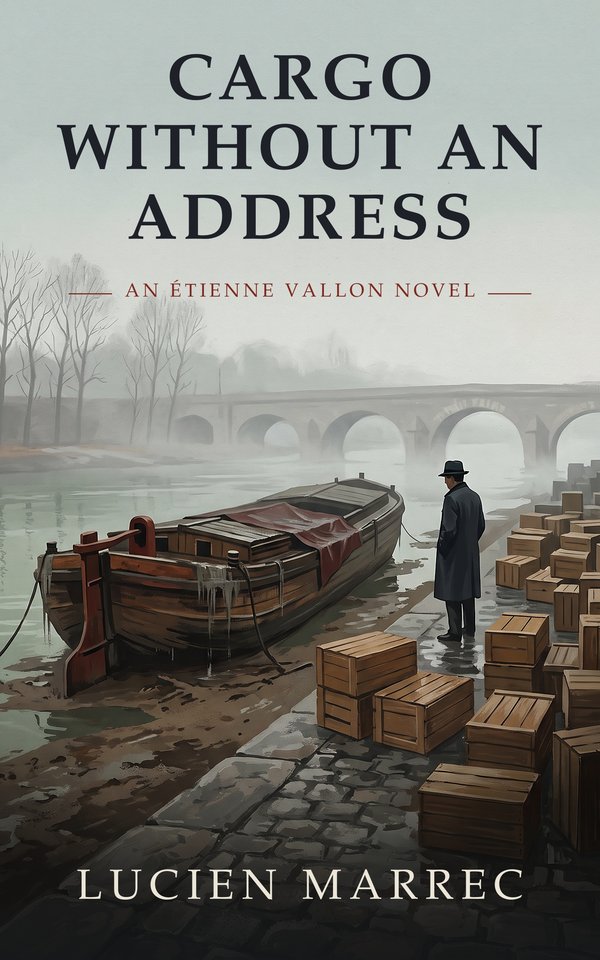
October 1936. The Seine is running low, and below Rouen they raise a barge that sank in June.
Three men went down with her. Her cargo was never declared.
Étienne Vallon, who investigates losses for a marine insurance society in Rouen, finds in her hold the same long pale nails he saw in Le Havre, and a crew-cabin door that was locked from the outside.
The waybill names no destination, only two words: à désigner. To be named on the way. Somebody is shipping crates south while France swears it is sending nothing to Spain, and the money is coming out of the very society Vallon works for.
The trail leads to Marseille: to the cashier he failed to protect three years ago, and to the man who was waiting at the door.
Ebook out 11 December 2026; paperback the same day.
Read the opening
The Seine had dropped three meters since August. At the bend below Rouen the bollards stood on bare mud, each with a green collar of slime where the water used to reach it, and beyond the bollards lay the barge, half out of the river, tilted on her side like a cow that had decided to stay down.
It was ten minutes to eight on Monday, the twelfth of October. Vallon had come by the workers’ tram and then a quarter of an hour on foot along the towpath, and the Maître’s note was in his coat pocket, folded in four. Hull claim, ninety thousand francs. Surveyor’s signature by Friday. I shall need it. M. No “please.” The Maître had used that word once, in a telegram in June, and Vallon had kept the telegram in his desk drawer beside the lump of red sealing wax without being able to say whether it was an apology or a confession.
Since then, twenty-two claims. A warehouse in Elbeuf, a tug with a cracked boiler, a widow’s cow, a hundred and sixty crates of calvados that had turned out to be a hundred and sixty crates of water. None of them had killed anyone. He had signed each one in black ink with the pen that had a crack in its cap, and each evening he had taken the 6:15 north to a tavern where the lamp was lit and a cup of coffee stood on the bar. He had not asked himself what that made of him. The question stood in the corner of every room, and he had learned to sit with his back to it.
The river had waited until October to give the barge back.
A tug lay alongside, hammering, with two fat hoses running from its deck into the barge’s hold. Water came out of the hoses in a brown rope and fell back into the river. Eight or nine men in hip boots were laying planks end to end across the mud, a footbridge to the hull. On the bow, white letters the river had eaten down to a few strokes: Providence. Oak, thirty-eight meters, built at Conflans before the war.
…